

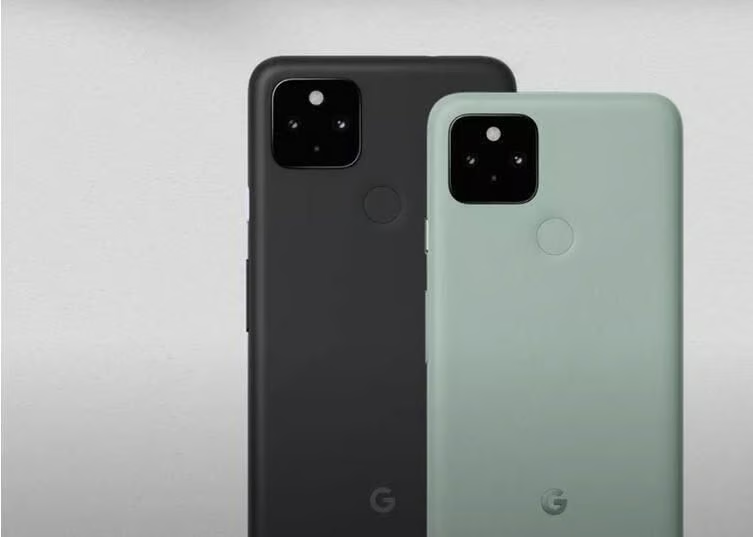
Google’s Pixel 5 smartphone features 5G connectivity, a 6-inch display, a front-facing hole-punch camera, and a rear-mounted fingerprint sensor.
Google introduced its latest Pixel smartphone with several new and updated features compared with the previous year’s Pixel 4. Unveiled during a launch event on September 30, the Pixel 5 was among the first two Pixel smartphones to support 5G, alongside the Pixel 4a 5G. In addition to next-generation cellular connectivity, the Pixel 5 includes a 6-inch OLED display with a 90Hz refresh rate, a Qualcomm Snapdragon 765G processor, 8GB of RAM, and 128GB of internal storage. Google priced the smartphone at $699 at launch.
What Are the Google Pixel 5’s Key Features?
The Google Pixel 5 introduced 5G connectivity with support for both sub-6GHz and mmWave networks. Sub-6GHz technology offers broader coverage, longer range, and better resistance to interference, but its more crowded spectrum can limit speeds and available bandwidth. mmWave, on the other hand, can deliver significantly faster speeds but has a shorter range and is more easily affected by obstacles and interference. As a result, mmWave generally performs best when users are relatively close to compatible cell towers.
In the United States, major carriers including AT&T, T-Mobile, and Verizon Wireless supported both types of 5G networks around the Pixel 5’s launch. mmWave was particularly associated with Verizon’s early 5G rollout.
The Pixel 5 also features a 6-inch always-on OLED display with a 1,080 × 2,340-pixel resolution, a 19.5:9 aspect ratio, and 24-bit color depth supporting up to 16 million colors. Its 90Hz refresh rate provides smoother scrolling and quicker screen updates than traditional 60Hz panels, although some premium smartphones offer refresh rates of up to 120Hz.
The display also supports HDR, which improves the contrast between bright and dark areas and helps produce a more detailed viewing experience when watching compatible content.
Here’s a polished rewrite in the same professional, SEO-friendly style:
The Pixel 5 comes with 8GB of RAM and 128GB of internal storage and is powered by Qualcomm’s Snapdragon 765G processor. While the 765G is not Qualcomm’s most powerful system-on-chip, it offers a solid balance of performance and efficiency for a midrange smartphone. The chip combines a 5G modem with Qualcomm’s AI Engine and an Adreno 620 GPU, providing capable graphics performance and efficient everyday operation.
For photography, the Pixel 5 features a dual-camera setup on the rear. Its primary 12.2-megapixel wide-angle camera has a 77-degree field of view, while the secondary 16-megapixel ultrawide camera expands coverage to 107 degrees. On the front, an 8-megapixel camera is positioned within a punch-hole cutout in the upper-left corner of the display.
Google also highlighted the Pixel 5’s combination of hardware and software features for photography and video recording. Portrait mode works with Night Sight to improve photos of people and objects in low-light and nighttime conditions. Portrait Light can also brighten subjects that are heavily backlit, helping preserve details that might otherwise be lost.
For video recording, the Pixel 5 offers three stabilization options: Locked, Active, and Cinematic Pan. Cinematic Pan is designed to produce smoother, more dramatic footage by slowing down camera movement and motion in the scene, giving users an effect inspired by professional filmmaking techniques.
The Pixel 5 supports 18W USB-C fast charging, wireless charging, and reverse wireless charging. Reverse charging allows the phone to share its battery power wirelessly with compatible accessories, such as earbuds. Its battery has a 4,080mAh capacity, while the Extreme Battery Saver mode can extend battery life by letting users choose which apps remain active while others are temporarily paused.
Durability was another consideration in the Pixel 5’s design. The rear panel is made from recycled aluminum, while the display is protected by Corning Gorilla Glass 6, which provides added resistance against everyday drops and scratches.
Google also introduced Hold for Me, a feature designed to make waiting on customer-service calls less frustrating. When activated, Google Assistant can monitor the call while the user waits on hold and notify them when it detects that a representative has returned to the line.
At launch, Google also offered several promotional benefits with the Pixel 5. Depending on the market and promotion, buyers could receive trial subscriptions and benefits including three months of Stadia Pro, three months of YouTube Premium, 100GB of Google One cloud storage, and access to Google Play Pass and Google Play Points.
Here’s a polished rewrite that keeps the technical details while making the comparison smoother and more natural:
How Does the Pixel 5 Compare With the Pixel 4?
Google released two Pixel 4 models in the previous generation: the standard Pixel 4 and the larger Pixel 4 XL. The Pixel 5 introduces several changes in display size, battery capacity, cameras, performance, and biometric authentication.
The Pixel 4 features a 5.7-inch FHD+ display with a resolution of 1,080 × 2,280 pixels, while the Pixel 4 XL has a larger 6.3-inch QHD+ panel with a 1,440 × 2,960-pixel resolution. The Pixel 5 sits between the two with a 6-inch OLED display and a 1,080 × 2,340-pixel resolution. Its size provides a practical balance for users who want a reasonably large screen without the added bulk of a larger phone.
Battery capacity is another area where the Pixel 5 improves significantly. The Pixel 4 has a 2,800mAh battery, while the Pixel 4 XL comes with a 3,700mAh battery. The Pixel 5 increases capacity to 4,080mAh. All three models support 18W fast charging and wireless charging, but the Pixel 5’s larger battery gives it an advantage for users who prioritize longer battery life.
Google also changed the rear camera configuration. The Pixel 4 uses a combination of wide-angle and telephoto cameras, while the Pixel 5 switches to two wide-angle cameras. The Pixel 4 has a 12.2-megapixel primary camera and a 16-megapixel telephoto camera. The Pixel 5 instead pairs a 12.2-megapixel wide-angle camera with a 16-megapixel ultrawide camera, giving users a wider perspective for landscapes, group shots, and other scenes.
Memory and storage also received an upgrade. The Pixel 4 includes 6GB of RAM and is available with either 64GB or 128GB of storage. The Pixel 5 increases RAM to 8GB and comes with 128GB of storage as its standard and only storage configuration.
The processors differ considerably between the two generations. The Pixel 4 is powered by Qualcomm’s Snapdragon 855, while the Pixel 5 uses the Snapdragon 765G. Although the Snapdragon 855 delivers higher raw performance, the Snapdragon 765G is designed to provide a better balance between performance and power efficiency. Combined with the Pixel 5’s larger battery, the more efficient processor can help the phone operate longer between charges.
Biometric authentication is another major difference. The Pixel 4 relies on Face Unlock, which uses sensors positioned around the top of the display. The Pixel 5 removes facial recognition and returns to a rear-mounted fingerprint sensor.
Face Unlock can be convenient in situations where users can easily look at their phone. However, fingerprint authentication can be more practical when wearing a face mask, since facial recognition may not work reliably when part of the face is covered. The Pixel 5’s fingerprint sensor therefore offers a straightforward alternative for unlocking the device.
Here’s a polished, SEO-friendly rewrite with the sidebar promotional text removed and the specifications organized for readability:
The Pixel 4 features Corning Gorilla Glass 5 on its front display, while the Pixel 5 upgrades to Gorilla Glass 6. According to Corning’s testing, Gorilla Glass 6 offers improved durability over its predecessor and can withstand drops from heights of up to 1.6 meters (5 feet, 2 inches) onto hard, rough surfaces.
What Are the Pixel 5’s Main Competitors?
With a launch price of $699, Google positioned the Pixel 5 firmly in the midrange smartphone market. This segment has become increasingly competitive as many buyers have become less willing to spend $1,000 or more on flagship smartphones.
The Pixel 5 competes with several midrange and value-focused devices, including the Samsung Galaxy S20 FE, Samsung Galaxy S10e, OnePlus Nord, and the 64GB iPhone 11. It also faced competition from more affordable smartphones offered by manufacturers such as Huawei, Xiaomi, and Oppo.
Google also had competition within its own Pixel lineup. At launch, consumers could choose among the Pixel 5, Pixel 4a, and Pixel 4a 5G, giving buyers several options at different price points. Apple’s upcoming 2020 iPhone lineup was another potential competitor, particularly with reports pointing to models such as the iPhone 12 and a smaller iPhone variant.
For buyers specifically looking for an affordable 5G smartphone, alternatives included the Pixel 4a 5G, Samsung Galaxy S20 FE 5G, and OnePlus Nord. Shoppers who were open to switching between Android and iOS could also consider waiting for Apple’s next-generation iPhone lineup before making a purchase.
Google Pixel 5 Specifications
| Category | Pixel 5 Specifications |
|---|---|
| Display | 6-inch always-on OLED, FHD+ (1,080 × 2,340 pixels), 432 ppi, 24-bit color depth, HDR, 19.5:9 aspect ratio, 90Hz refresh rate |
| Build | Corning Gorilla Glass 6 front; 100% recycled aluminum enclosure |
| Storage | 128GB |
| Memory | 8GB LPDDR4x RAM |
| Processor | Qualcomm Snapdragon 765G, 2.4GHz octa-core, Adreno 620 GPU, Titan M Security Module |
| Rear Main Camera | 12.2MP dual-pixel sensor, 1.4μm pixel width, dual-pixel phase-detection autofocus, optical and electronic image stabilization, ƒ/1.7 aperture |
| Rear Ultrawide Camera | 16MP ultrawide, 1.0μm pixel width, ƒ/2.2 aperture |
| Front Camera | 8MP, 1.12μm pixel width, ƒ/2.0 aperture, fixed focus |
| Rear Video | 1080p at 30, 60, 120, and 240fps; 4K at 30 and 60fps |
| Front Video | 1080p at 30fps |
| Battery | Minimum 4,000mAh; typical capacity of 4,080mAh |
| Security | Pixel Imprint rear-mounted fingerprint sensor |
| Ports & SIM | USB-C; dual SIM with nano-SIM and eSIM support |
Wireless Connectivity
- Wi-Fi: 2.4GHz and 5GHz 802.11a/b/g/n/ac with 2×2 MIMO
- Bluetooth: Bluetooth 5.0 with Low Energy (LE)
- Audio: A2DP with support for HD codecs including aptX, aptX HD, and LDAC
- NFC: Supported
- Google Cast: Supported
- Navigation: GPS, GLONASS, Galileo, and QZSS
Cellular Connectivity
- 5G Sub-6GHz: Supports TDD configurations up to 1CC × 100MHz with 4×4 MIMO for downlink and 1CC × 100MHz for uplink. FDD supports up to 1CC × 20MHz with 4×4 MIMO for downlink and 1CC × 20MHz for uplink.
- 5G mmWave: Supports TDD configurations of up to 4CC × 100MHz with 2×2 MIMO for downlink and 1CC × 100MHz with 2×2 MIMO for uplink.
- LTE: Supports up to 4CC with 12-layer downlink and 2CC uplink.
Sensors
The Pixel 5 includes a proximity and ambient-light sensor, accelerometer and gyroscope, magnetometer, barometer, and spectral and flicker sensors.
Charging
The phone supports 18W fast charging through USB-C using USB Power Delivery 2.0. It also supports Qi-compatible wireless charging and reverse wireless charging for powering compatible accessories.
Buttons and Ports
The Pixel 5 features a USB Type-C 3.1 Gen 1 port, along with dedicated power and volume buttons.
SIM Support
The phone supports a single physical nano-SIM alongside an eSIM.
Media and Audio
Audio features include stereo speakers, three microphones, and noise-suppression technology for clearer calls and recordings.
Durability
The Pixel 5 carries an IP68 rating for protection against dust and water.
Operating System
The smartphone launched with Android 11 and was promised at least three years of operating-system and security updates.
Dimensions and Weight
The Pixel 5 measures 144 × 70.4 × 8mm and weighs approximately 151g (5.03 ounces).
Colors
Google offered the Pixel 5 in Just Black and Sorta Sage, a green color option.
What’s Included in the Box
The package includes an 18W USB-C power adapter, a 1-meter USB-C-to-USB-C cable, Quick Start Guide, Quick Switch Adapter, and SIM tool.
Launch Price
The Google Pixel 5 launched at $699.
Why Should Businesses and Professionals Consider the Pixel 5?
The Google Pixel 5 offers several features that may appeal to business users, professionals, and organizations. Its support for 5G provides faster connection speeds, greater network capacity, and lower latency when used with compatible 5G networks. Even for users who do not currently have access to 5G, the technology gives the Pixel 5 a degree of future-readiness as next-generation networks become more widely available.
Security is another important advantage for professional users. Like the Pixel 3 and Pixel 4, the Pixel 5 includes Google’s Titan M security chip, which is designed to provide hardware-backed protection for the device.
Titan M works with the phone’s bootloader to help verify that the operating system has not been tampered with or maliciously modified. It also helps protect user data by encrypting the device when it is locked and uses secure APIs to help ensure that only trusted applications can access protected areas of the system.
For businesses handling sensitive information, these hardware-level security measures can provide an additional layer of protection alongside Android’s built-in security features and organizational device-management tools.
For users who regularly capture photos and videos for personal or professional purposes, the Pixel 5’s enhanced camera features can help produce better-quality images and smoother footage. Google’s combination of camera hardware and software processing is designed to improve results across a range of lighting and shooting conditions.
The Pixel 5 also includes Google’s Personal Safety app, which provides features designed to help users during emergencies. For example, the app can automatically contact 911 when it detects a vehicle crash and can schedule safety checks that alert designated emergency contacts if a user fails to respond. These tools can be particularly useful for people who travel frequently, work alone, or spend time in remote locations.
Another benefit of choosing a Google-made smartphone is timely Android software updates. Pixel devices typically receive Android updates and security patches directly from Google, allowing users to access important fixes and new features without waiting for lengthy carrier or manufacturer update cycles.
When and Where Was the Pixel 5 Available?
Google opened Pixel 5 preorders on September 30, with the phone scheduled to reach retail stores on October 15. At launch, the Pixel 5 was available in the United States, Canada, the United Kingdom, Ireland, France, Germany, Japan, Taiwan, and Australia.
In the United States, customers could purchase the Pixel 5 through Verizon and Google Fi, as well as buy an unlocked version compatible with major wireless carriers.
Here are 7 SEO-friendly FAQs for your Google Pixel 5 article:
Frequently Asked Questions
What are the key features of the Google Pixel 5?
The Google Pixel 5 features a 6-inch OLED 90Hz display, Snapdragon 765G processor, 8GB of RAM, 128GB of storage, 5G connectivity, dual rear cameras, wireless charging, and a rear-mounted fingerprint sensor.
Does the Google Pixel 5 support 5G?
Yes. The Pixel 5 supports both sub-6GHz and mmWave 5G networks, depending on the model and region.
How good is the Pixel 5 camera?
The Pixel 5 has a 12.2MP main rear camera and a 16MP ultrawide camera. Google also includes software features such as Night Sight, Portrait Light, and multiple video stabilization modes.
How much RAM and storage does the Pixel 5 have?
The Pixel 5 comes with 8GB of LPDDR4x RAM and 128GB of internal storage. There is no microSD card slot for additional storage.
How long does the Pixel 5 battery last?
The Pixel 5 has a typical battery capacity of 4,080mAh. Its power-efficient Snapdragon 765G processor and Extreme Battery Saver mode can help extend battery life.
Is the Google Pixel 5 water-resistant?
Yes. The Pixel 5 has an IP68 rating, providing protection against dust and water under specified testing conditions.
Is the Google Pixel 5 good for business and professional users?
Yes. Its 5G connectivity, timely Android and security updates, Titan M security chip, strong camera system, and battery-saving features make it a practical option for many professionals and mobile workers.
Conclusion
The Google Pixel 5 combines 5G connectivity, a smooth 90Hz OLED display, capable cameras, strong battery capacity, and hardware-backed security in a compact design. Its Snapdragon 765G processor and 8GB of RAM provide dependable performance for everyday tasks, while features such as wireless charging, Extreme Battery Saver, and Titan M security add practical value.
For professionals and business users, timely Android updates, security features, and 5G support make the Pixel 5 a capable option. Although newer smartphones offer more powerful hardware today, the Pixel 5 remains notable for its balanced feature set, clean Android experience, and focus on security and usability.
